
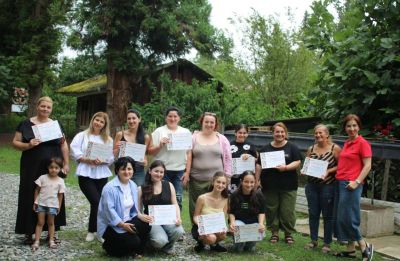
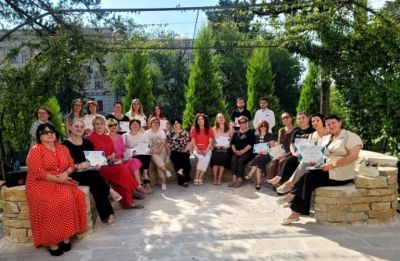
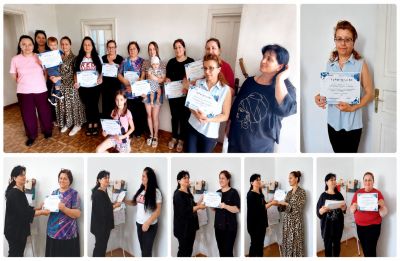
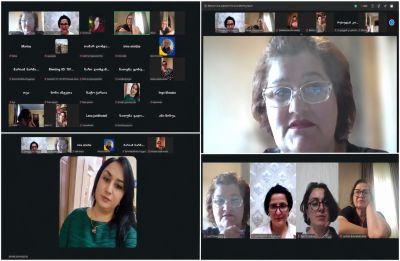
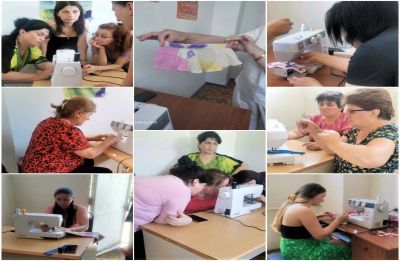
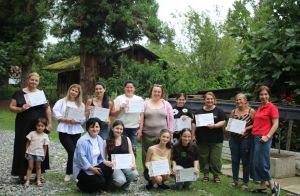
A basic makeup artistry course has been completed in the Kombinati settlement of Zugdidi. The training began on 13 July and aimed to develop women’s practical professional skills and support their economic empowerment.
Local women, including young mothers, participated in the course. Acquiring a new profession creates opportunities for their employment and self-employment.
During the training, the participants gained basic theoretical knowledge and practical skills in makeup artistry and took their first steps towards professional activity.
The experience will allow them to continue their education through an advanced course, further develop their practical skills and turn makeup artistry into a source of income.
Access to vocational education and support for women’s economic independence are essential to their empowerment and the creation of new opportunities in life.
The project is implemented with the support of CISU
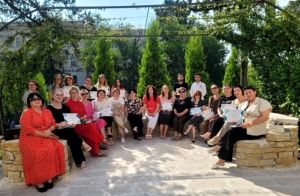
On 25 July, a training entitled “The Role of Teachers in Trauma-Informed Communication and Support for Women Survivors of Domestic Violence” was held at Gelati Residence Hotel in Kutaisi. The event brought together 21 teachers from the municipalities of Kutaisi, Khoni, Tskaltubo, Senaki, and Zugdidi.
During the training, participants explored the dynamics of domestic violence, the impact of trauma, the principles of trauma-informed communication, referral mechanisms, and the role of education professionals in responding to cases of violence. The programme combined theoretical sessions with practical case studies and interactive group work.
Participants expressed particular interest in the topic of online violence, highlighting its growing relevance in educational settings. They noted that the knowledge and practical tools gained during the training would be directly applicable to their daily professional work, while the analysis of real-life cases made the learning process especially valuable and practice-oriented.
The project is implemented with the support of CISU
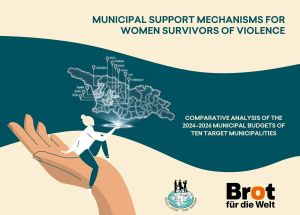
The Cultural-Humanitarian Fund “Sukhumi” presents a comparative analysis of the 2024-2026 budgets of 10 target municipalities. The document examines how women’s needs and municipal response mechanisms to domestic violence are reflected in local programs; what types of support municipalities offer to women survivors of violence; and whether this support creates a pathway from crisis assistance to safe housing, psychosocial support, economic empowerment, and opportunities for independent living.
The project is implemented with the support of the organization Brot
für die Welt - Evangelischer Entwicklungsdienst (Germany)
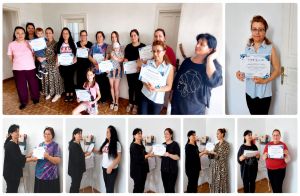
A basic one-month cutting and sewing course has been completed in the Kopitnari settlement within the framework of the Danner project. The aim of the course was to develop women’s practical skills and support their economic empowerment.
During the month, participants learned basic sewing techniques, worked on practical assignments, and created their first handmade items. At the end of the course, they were awarded certificates.
According to the participants, the course was not only about gaining a professional skill. It was also an opportunity to gain more confidence in their own abilities, discover a new interest, and think about how the knowledge they acquired could contribute to their personal and economic empowerment in the future.
“At first, I thought I would not be able to do it, but when I saw something I had sewn with my own hands, I discovered a new strength in myself,” said one of the participants.
Similar activities planned within the project help strengthen women’s self-confidence, develop practical skills, and expand their opportunities at the local level.
The project is implemented with the support of CISU
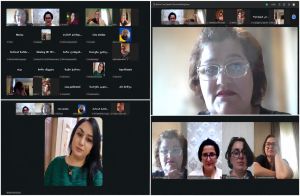
Women Fund “Sukhumi” held a joint online information meeting on the topic: “Trauma-Informed Approaches in the Context of Domestic Violence.”
The meeting brought together representatives of 10 municipalities. Participants summarized the knowledge gained during the workshops, shared practical experience, and discussed how trauma-informed approaches can be used in the process of supporting women who have experienced violence.
During the discussion, it was emphasized that a trauma-informed approach is not only about empathy. It is a way of better understanding a woman’s experience, fear, silence, complex reactions, and decisions. According to the participants, this knowledge helps specialists and community representatives create more safety and less judgment when working with women affected by violence.
Participants also noted that, after the workshops, it became clearer why a woman may not be ready to speak during the first meeting, why asking for help can be difficult, and how important trust-based communication is in the support process.
The meeting also highlighted key needs at the local level: wider introduction of trauma-informed approaches, strengthening of services, capacity building for specialists, and development of network-based cooperation.
Participants underlined that such spaces are important for sharing experience, identifying common challenges, and developing more effective practices for supporting women.
The project is implemented with the support of CISU
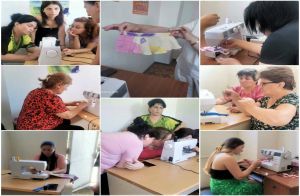
A sewing course for women has started in Kopitnari settlement, Tskaltubo Municipality.
The course gives participants the opportunity to learn a new practical skill, gain professional experience and become part of a space that, alongside learning, also offers opportunities for communication, self-expression and empowerment.
During the first meeting, the participants were introduced to the aim of the course, the working process and the main topics they will gradually study over the coming weeks. The meeting was held in a warm and productive atmosphere. The participants expressed interest, curiosity and a clear desire to turn new knowledge into real opportunities.
Sewing is not only a technical skill. At first glance, it begins with a needle, thread and fabric, but often it means much more — gaining new experience, building confidence in one’s abilities and developing a clearer vision for the future.
Courses of this kind are especially important for women who need support, the development of new skills and practical steps towards social and economic empowerment.
Over the next few weeks, the participants will gain new knowledge, engage in practical work, share experiences and, perhaps, discover opportunities that at the beginning of the course existed only as expectations.
The project is implemented with the support of CISU
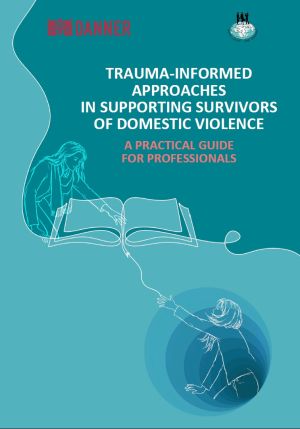
Women’s Fund “Sukhumi”, in partnership with Danner, has developed a practical guide — “Trauma-Informed Approaches in Supporting Women Survivors of Violence.”
The guide is intended for specialists who work with women survivors of violence and are involved in the process of their support, protection and empowerment. This includes social workers, case managers, psychologists, lawyers, staff of shelters and day centres, paraspecialists and representatives of community-based services.
The document helps specialists better understand the dynamics of domestic violence, mechanisms of power and control, and the impact of trauma on women’s emotional responses, behaviour and decision-making processes. The guide brings together both theoretical foundations and practical recommendations on how to provide support in a way that safeguards women’s safety, dignity, trust and autonomy of choice.
The guide covers topics such as forms of domestic violence, coercive control, the cycle and spiral of violence, the impact of violence on women and children, trauma responses, trauma-informed communication, and self-care for specialists.
The publication was prepared within the framework of the project “Empowering Women Survivors of Violence and Developing Community-Based Support Systems in Georgia” and is based on international practice, Danner’s experience and the long-standing work of Women’s Fund “Sukhumi” in supporting women survivors of violence.
The project is implemented with the support of CISU
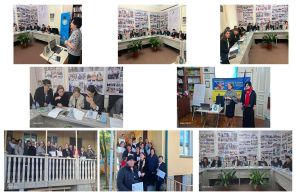
On May 6, in Kutaisi, the Charity Humanitarian Women Fund “Sukhumi” organized a training for medical personnel on the topic: “The Role of Medical Personnel in Trauma-Informed Communication and Support for Women Survivors of Domestic Violence.”
The training brought together 20 medical professionals - doctors and nurses from Kutaisi, Tskaltubo, Khoni, Senaki, and Zugdidi.
The main goal of the meeting was to raise awareness among medical personnel about trauma-informed approaches, sensitive communication, and response mechanisms in cases of domestic violence. Participants discussed the impact of stereotypical attitudes, the emotional state of women after trauma, and how the first contact with medical personnel can become the beginning of support and a sense of safety for women.
One of the important parts of the training was dedicated to the referral mechanism. Within the block facilitated by Ema Kamkia, participants discussed the roles of the actors involved in the referral process, the responsibilities of medical personnel, documentation issues, cooperation with relevant agencies, and risk assessment mechanisms.
The block on trauma-informed communication was facilitated by Khatuna Gogua. Participants worked on how communication with a woman survivor of violence should be conducted in a way that does not deepen her fear, shame, or sense of insecurity.
During the discussion, participants noted that referral documentation should be more compact and practical, so that it can be used more effectively in real working environments and does not create additional discomfort either for the survivor or for medical personnel.
“We, doctors, have never participated in trainings on such topics before. We received information that is not only important, but necessary for our work,” one of the participants noted.
“We are leaving emotionally and informationally enriched. We reflected on our own responsibility. In our practice, we often come into contact with women survivors of violence, and communication with them is especially important,” said another participant.
At the end of the meeting, participants emphasized the importance of sharing experience and gaining practical knowledge. The training once again highlighted that, when working with women survivors of violence, the role of medical personnel is not limited only to diagnosis and treatment — it is also connected to women’s safety, trust, and support.
The project is implemented with the support of CISU
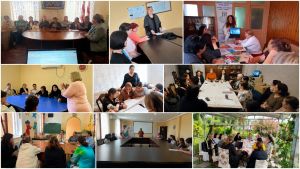
Organized by the Women Fund “Sukhumi”, a specialized cycle of workshops on trauma-informed approaches to working with women in the community has been completed. The cycle started in May and covered 10 municipalities.
The meetings were held in Kutaisi, Khoni, Tskaltubo, Vani, Terjola, Senaki, Khobi, Zugdidi, Tsalenjikha and Chokhatauri. In total, 100 women participated in the workshops.
The main goal of the working meetings was to provide women with information on recognizing the signs of violence, understanding the impact of trauma, and identifying safe forms of support. Participants discussed why violence may remain unnoticed for a long time, what role fear, silence and societal attitudes play, and why non-judgmental, careful and support-based communication is important.
In their evaluations, participants particularly emphasized the need for such meetings. According to them, the knowledge gained helps women better recognize the signs of violent relationships, both in their own experiences and in the experiences of others.
The cycle once again demonstrated that working with women in the community through a trauma-informed approach is important for creating a safe environment — one where conversation begins not with judgment, but with listening, support and respect for a person’s experience.
The project is implemented with the support of CISU
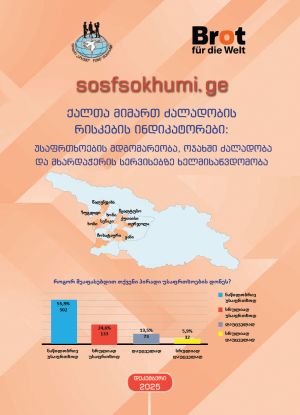
The publication prepared by the Women Fund “Sukhumi” is based on a quantitative study conducted in November–December 2025, involving 540 women respondents from 10 municipalities of Western Georgia: Tskaltubo, Kutaisi, Khoni, Terjola, Vani, Chokhatauri, Senaki, Zugdidi, Tsalenjikha and Khobi. The study examines women’s safety, experiences of domestic violence and technology-facilitated violence, as well as awareness of, access to and trust in support services.
The study revealed that women’s safety is most affected by unemployment, the risk of losing a job, poverty, migration and insufficient access to services. Stigma surrounding domestic violence also remains a significant problem, often preventing women from openly acknowledging their personal experiences and seeking help. The data also showed that, despite increased awareness of available services, many women still do not have precise information about whom to contact and how to seek assistance in cases of violence or danger.
One of the key findings of the publication is that preventing violence and protecting women cannot be achieved through information-sharing alone. It is essential to strengthen reliable, confidential, geographically and financially accessible services, especially for vulnerable groups: internally displaced women, socially vulnerable women, women living in rural areas and women responsible for caring for persons with disabilities or older family members.
The project is implemented with the support of Brot für die Welt – Evangelischer Entwicklungsdienst (Germany)